
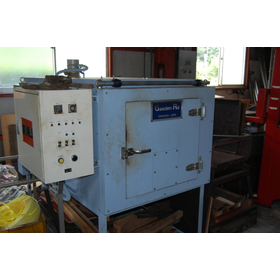
We have compiled a list of manufacturers, distributors, product information, reference prices, and rankings for High-frequency heat treatment.
ipros is IPROS GMS IPROS One of the largest technical database sites in Japan that collects information on.

High-frequency heat treatment - List of Manufacturers, Suppliers, Companies and Products

High-frequency heat treatment Product List

1~5 item / All 5 items

Displayed results

Yamanashi High-Frequency Industries

Surface heat treatment (high-frequency heat treatment) of metal parts tailored to applications based on years of experience and achievements, with support for small lots and short delivery times.

Yamanashi High Frequency Industrial specializes in high-frequency heat treatment (induction hardening) based on many years of experience and achievements. We excel in surface heat treatment for industrial machinery components such as shafts, gears, rollers, various tools, and jacks. Our technology allows us to heat and cool only the necessary areas to the required depth, accommodating small lot sizes and short delivery times. Our main clients include Sankyo Oil-less Industry Co., Ltd. and Citizen Watch Manufacturing Co., Ltd.

Added to bookmarks

Bookmarks list

Bookmark has been removed

Bookmarks list

You can't add any more bookmarks

By registering as a member, you can increase the number of bookmarks you can save and organize them with labels.

Free membership registration

[Case Study of Solution through IH Heat Treatment] Out of tolerance due to distortion.

Our company is engaged in efforts and development to minimize distortion in various components.

There are various factors that cause dimensional changes, but broadly speaking, they can be categorized into two main types: "dimensional changes due to the release of residual stress" and "dimensional changes due to structural transformation (phase change)." Minimizing distortion in precision parts is extremely important, as forcing correction can lead to the risk of cracking, and the strength gained from hardening will undoubtedly decrease. Therefore, our company is engaged in efforts and development to minimize distortion in various components. In particular, when changing processes from atmospheric treatment to high-frequency hardening, significant effects can be expected. If you have concerns about distortion, please feel free to consult us. *For more details, please refer to the PDF document or feel free to contact us. ★ For inquiries by phone, please call: Osaka Headquarters → TEL: 072-991-1361 Nagoya → TEL: 052-322-1361 Tokyo → TEL: 03-5472-1361 *When calling, please mention that you saw us on "Ipros." Operating hours: Monday to Friday, from 9 AM to 5 PM.

  • Processing Contract

Added to bookmarks

Bookmarks list

Bookmark has been removed

Bookmarks list

You can't add any more bookmarks

By registering as a member, you can increase the number of bookmarks you can save and organize them with labels.

Free membership registration

[Case Study on Solving Heat Treatment Issues 1] A must-see for those struggling with hardness!

Not enough hardness? If the material's structure is not appropriate, no matter how much you harden it, the hardness will not increase!

No matter how much ferrite is heated and cooled, its hardness does not increase. Especially in the case of casting, a minimum pearlite rate of 70% or more is necessary for stable quenching. The material can affect the quality of heat treatment. Particularly with castings, there tends to be significant variation between batches, so caution is required. At Fuji Electronics, we have various inspection equipment in-house, including X-ray metal material analyzers, allowing for the rapid identification of root causes. *For more details, please refer to the PDF materials or feel free to contact us.

  • Other inspection equipment and devices

Added to bookmarks

Bookmarks list

Bookmark has been removed

Bookmarks list

You can't add any more bookmarks

By registering as a member, you can increase the number of bookmarks you can save and organize them with labels.

Free membership registration

High-frequency heat treatment

Partially harden. Optimal heat treatment with advanced technology.

Only the parts that require wear resistance can be hardened through surface hardening using electromagnetic induction. Due to rapid heating and rapid cooling, there is minimal oxidation and decarburization on the surface, and no thermal deformation occurs, resulting in excellent wear resistance. By changing the frequency, the depth of hardening can be adjusted, allowing for processing in a short time. Because very fast heating occurs, the know-how of skilled craftsmen is required. ● Heating coils suitable for the product shape are necessary. ● Detailed prior discussions will be conducted to perform heat treatment suitable for the material. ● Surface hardening allows the interior to remain as the original material while maintaining high toughness.

  • Steel

Added to bookmarks

Bookmarks list

Bookmark has been removed

Bookmarks list

You can't add any more bookmarks

By registering as a member, you can increase the number of bookmarks you can save and organize them with labels.

Free membership registration

Technical Introduction: "High-Frequency Heat Treatment"

Capable of handling everything from large products to precision parts!

High-frequency hardening is a process that can be described in one word as heating and cooling only the necessary parts to harden them. 【Principle】 1. Utilizing the phenomenon of electromagnetic induction Electromagnetic induction occurs when a coil A connected to a power source is placed near another coil B (both coils are in a non-contact state) and the power is turned on, generating a magnetic field. At this moment, a current is induced in coil B as well. (The same occurs when the power is cut off.) The phenomenon of current being induced in coil B is called electromagnetic induction. 2. Heating the product with the induced current By using the current (eddy current) induced by electromagnetic induction, placing the product (metal) instead of coil B allows current to flow through the product. When current flows through the product, Joule heat is generated due to resistance, and the product is efficiently heated through a direct heating method as it self-heats. 3. Heating only the necessary depth of the necessary parts By shaping coil A to match the shape of the part of the product that needs to be heated, only the necessary parts are heated. The higher the frequency of the power source, the more the induced current concentrates on the surface of the product (this is called the skin effect). The frequency is selected arbitrarily based on the product shape (size) and the desired depth of the hardened layer. ● For more details, please contact us.

  • others

Added to bookmarks

Bookmarks list

Bookmark has been removed

Bookmarks list

You can't add any more bookmarks

By registering as a member, you can increase the number of bookmarks you can save and organize them with labels.

Free membership registration